Black Peptide
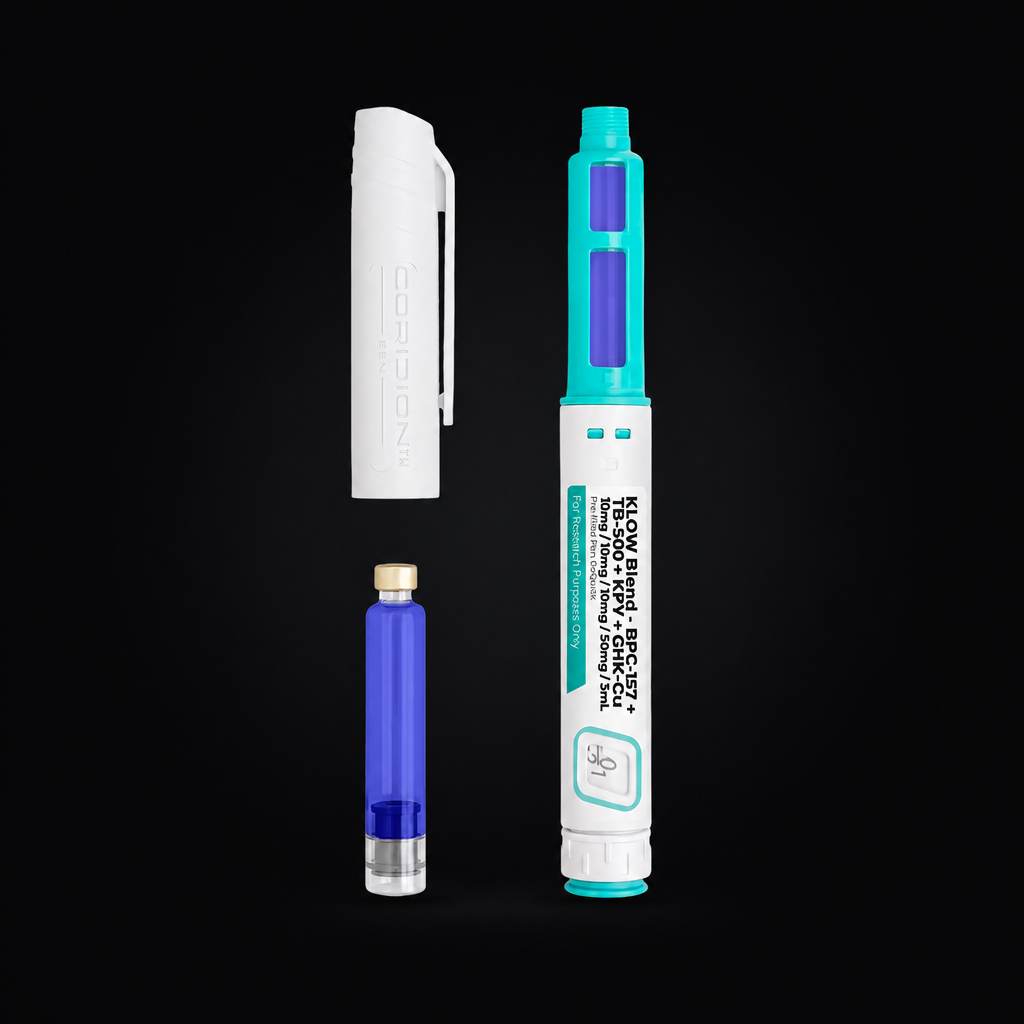
KLOW Blend | BPC-157 (10 mg), TB-500 (10 mg), GHK-Cu (50 mg), and KPV (10 mg)
KLOW Blend | BPC-157 (10 mg), TB-500 (10 mg), GHK-Cu (50 mg), and KPV (10 mg)
Couldn't load pickup availability
Description
Klow Blend is an advanced regenerative peptide complex combining BPC-157, TB-500, GHK-Cu, and KPV to enhance tissue repair, collagen formation, and mitochondrial energy balance. This formulation builds on the Glow Blend by adding KPV, which supports oxidative stress regulation and energy metabolism.
In research settings, Klow Blend has demonstrated improved muscle and tendon recovery, enhanced collagen synthesis, and anti-inflammatory activity through the complementary mechanisms of its components. The inclusion of KPV contributes mitochondrial support and antioxidant protection, allowing for deeper regenerative and longevity applications.
The synergy between these peptides promotes angiogenesis, fibroblast proliferation, and connective tissue integrity, while minimizing fibrosis and scarring. It is studied for use in models of full-body recovery, cellular energy restoration, and anti-aging.
Formulated in a stabilized pre-mixed injection pen for SubQ administration, Klow Blend ensures optimal bioavailability and consistent absorption in systemic regenerative and rejuvenation studies.
Clinical Status:
Klow Blend is a multi-pathway peptide formulation evaluated in experimental research for recovery, mitochondrial support, and longevity enhancement. It is intended solely for non-therapeutic laboratory research.
Evidence Type:
Human RCT ☐ | Observational ✔ | Animal ✔ | In vitro ✔ | Regulatory ☐
Mechanism of Action
Klow Blend operates through complementary bioactive cascades.
- BPC-157 activates VEGF and nitric oxide signaling, enhancing angiogenesis and fibroblast-driven matrix deposition.
- TB-500 (a Thymosin Beta-4 fragment) improves cell migration via actin modulation (G-actin-Tβ4 complex) and supports endothelial regeneration.
- GHK-Cu regulates TGF-β, SMAD, and MMP signaling, stimulating collagen, elastin, and glycosaminoglycan synthesis while reducing oxidative stress.
- KPV modulates vascular permeability and cytokine expression, providing anti-inflammatory protection and balanced tissue perfusion.
This four-peptide synergy offers a multidimensional regenerative framework, ideal for researching tissue remodeling, dermal repair, and inflammation control.
Benefits
-
Advanced Multi-Pathway Regeneration Formula:
The Klow Blend integrates BPC-157, TB-500, GHK-Cu, and KPV to provide a next-generation synergistic model for whole-body regeneration. This advanced formulation simultaneously targets cellular repair, inflammation control, collagen synthesis, and vascular rejuvenation. The addition of KPV enhances mitochondrial energy balance and systemic recovery, making Klow Blend an evolution of the original Glow formulation. -
Comprehensive Tissue Repair and Recovery:
BPC-157 and TB-500 form the regenerative foundation of the blend, accelerating muscle, tendon, and ligament healing by stimulating fibroblast activity and angiogenesis. GHK-Cu complements these effects by promoting collagen and elastin production, while KPV contributes to mitochondrial stabilization and reduced oxidative stress, creating a complete recovery environment for damaged tissues. -
Enhanced Collagen Synthesis and Structural Integrity:
GHK-Cu and BPC-157 synergistically improve collagen matrix formation, while TB-500 regulates actin polymerization for optimal cell alignment. KPV supports cellular metabolism during collagen synthesis, enhancing tensile strength, elasticity, and long-term resilience of repaired tissues in dermal and musculoskeletal research models. -
Accelerated Wound Healing and Skin Regeneration:
The combination promotes rapid epithelial regeneration, angiogenesis, and fibroblast proliferation. GHK-Cu enhances dermal density and hydration, while BPC-157 and TB-500 accelerate wound closure and tissue remodeling. KPV reduces oxidative stress in the healing environment, optimizing recovery outcomes in skin repair and post-procedural regeneration research. -
Improved Microcirculation and Oxygen Delivery:
All four peptides in Klow Blend support vascular regeneration and oxygen supply to healing tissue. TB-500 stimulates VEGF expression and endothelial migration, BPC-157 stabilizes capillary walls, GHK-Cu promotes angiogenesis, and KPV enhances mitochondrial oxygen utilization. This coordinated vascular activation supports tissue vitality and energy availability during recovery. -
Reduced Inflammation and Oxidative Stress:
KPV introduces powerful anti-inflammatory and antioxidative regulation to the blend, complementing the cytokine-reducing effects of BPC-157 and GHK-Cu. Together, they decrease levels of TNF-α, IL-6, and CRP, preventing chronic inflammation and promoting a stable biochemical environment for regeneration and repair. -
Support for Joint Health and Connective Tissue Elasticity:
The blend improves cartilage repair and connective tissue flexibility by enhancing collagen synthesis, chondrocyte activation, and anti-fibrotic action. BPC-157 and TB-500 provide structural recovery, GHK-Cu supports remodeling, and KPV minimizes oxidative degradation of joint tissues, promoting long-term joint integrity and resilience. -
Mitochondrial Protection and Energy Optimization:
KPV plays a crucial role in maintaining mitochondrial integrity and ATP production, allowing tissues to regenerate more efficiently under metabolic stress. Combined with BPC-157’s nitric oxide regulation and GHK-Cu’s antioxidant gene activation, this synergy ensures optimal cellular energy flow and resilience during tissue recovery research. -
Anti-fibrotic Activity and Scar Reduction:
Klow Blend modulates TGF-β signaling to minimize fibrosis and excessive scar formation. GHK-Cu regulates extracellular matrix remodeling, BPC-157 aligns collagen fibers, TB-500 promotes orderly cell migration, and KPV reduces free radical-mediated tissue stiffness, resulting in smoother and more functionally superior regeneration outcomes. -
Improved Skin Tone, Elasticity, and Hydration:
GHK-Cu’s effect on skin texture and firmness is enhanced by BPC-157’s microvascular repair and KPV’s role in maintaining hydration and antioxidants. This synergy supports a radiant, elastic, and hydrated skin appearance, forming a strong foundation for experimental use in rejuvenation and aesthetic restoration research. -
Neuroprotective and Cognitive Support Effects:
BPC-157’s ability to promote neuronal repair is complemented by KPV’s mitochondrial protective effects in neural tissue. Alongside GHK-Cu’s copper-mediated anti-inflammatory and neurotrophic actions, the blend supports experimental studies exploring neuroregeneration, stress recovery, and cognitive performance enhancement. -
Systemic Anti-Aging and Longevity Pathways:
Klow Blend acts on multiple biological pathways associated with longevity, including mitochondrial protection, gene expression modulation, and inflammation reduction. This multi-mechanistic approach helps maintain youthful cellular behavior, energy balance, and regenerative capacity, positioning Klow Blend as an advanced model in anti-aging and vitality research. -
Synergistic Whole-Body Regeneration Effect:
By integrating four powerful regenerative peptides, Klow Blend offers a comprehensive profile of repair and rejuvenation across dermal, muscular, neural, and vascular systems. Each component targets a different regenerative mechanism, creating a harmonized model of systemic recovery and structural renewal unparalleled in modern peptide research formulations.
Research Data
| Study/Model | Reported Effect |
| BPC-157 muscle injury models |
↑ Healing rate, ↑ capillary density, ↓ inflammatory cytokines |
| TB-500 tendon repair studies |
↑ Cell migration and actin reorganization, ↑ angiogenesis |
| GHK-Cu skin regeneration (human fibroblasts) |
↑ Collagen I/III and elastin expression |
| KPV endothelial models |
↓ Vascular permeability, ↓ oxidative damage, ↑ nitric oxide modulation |
| Combined peptide models |
↑ ECM remodeling and ↑ angiogenic factor expression |
| Rodent dermal wound studies |
↑ Epithelialization rate, ↓ fibrosis, ↑ antioxidant enzyme levels |
| Skin aging assays |
↑ Dermal hydration and elasticity, ↓ oxidative biomarker levels |
Combination Suggestions
Klow Blend already provides a comprehensive matrix of regeneration and rejuvenation.
However, for advanced experimental models, it can be combined with NAD+ (for mitochondrial redox optimization) or SS-31 (for enhanced mitochondrial membrane protection).
Discussed combinations are for experimental design purposes only, not for safety or efficacy guidance.
Dosing Table for Pen
| Klow Blend Pen 80 mg | |
| Volume | 2.0 mL |
| mg/mL | 40 mg/mL |
| Click-per-Dose | 1 click = 0.40 mg |
| Examples | 10 clicks = 4.00 mg |
Dosing and Protocol Variations
Standard Regeneration Protocol
- Dose: 4 mg (= 10 clicks)
- Duration: 4 – 8 weeks
- Frequency: 1× daily
- Cycle Interval: 4 – 8 weeks off, then repeat
- Objective / Description: Designed for general regeneration and recovery studies
Intensive Repair Protocol
- Dose: 8 mg (= 20 clicks)
- Duration: 4 – 6 weeks
- Frequency: 1× daily
- Cycle Interval: 4 – 8 weeks off
- Objective / Description: Used in acute injury and tissue healing research
Possible Side Effects
Klow Blend, as a research peptide blend, may cause side effects in experimental models, primarily from regenerative and immune actions via subcutaneous injection. Effects are generally mild, varying with dosage. Monitoring ensures protocol safety.
Injection Site Reactions: Redness or swelling, resolving quickly from local activation.
Nausea: Mild stomach upset, related to BPC-157 and KPV effects, transient initially.
Fatigue: Short-term energy dips from metabolic demands.
Allergic Responses: Rare rashes, possibly from GHK-Cu or KPV in sensitive individuals.
Joint Discomfort: Temporary during remodeling.
Pigmentation Changes: Potential changes from GHK-Cu or KPV, reversible.
It is crucial to note that most side effects are transient and adjustable. Rare issues such as elevated inflammation require observation.
Product Attributes
- CAS #: 218949-48-5
- Molecular formula: C221H366N72O67S
- Sequence (AA): Tyr-DAla-Asp-Ala-Ile-Phe-Thr-Asn-Ser-Tyr-Arg-Lys-Val-Leu-Gly-Gln-Leu-Ser-Ala-Arg-Lys-Leu-Leu-Gln-Asp-Ile-Met-Ser-Arg-Gln-Gln-Gly-Glu-Ser-Asn-Gln-Glu-Arg-Gly-Ala-Arg-Ala-Arg-Leu-NH2
- Molecular weight: 5135.87 g/mol
- PubChem CID: 10492583
- Half-life: ~30 minutes (extended biological activity up to 2 hours)
- Synonyms: TH9507, tesamorelin acetate, Egrifta SV WR, hGRF / GHRH / growth hormone-releasing factor analog
- Type: Synthetic GHRH analog
- Research focus: Weight Loss, Anti-Aging, Endocrine Regulation
Share